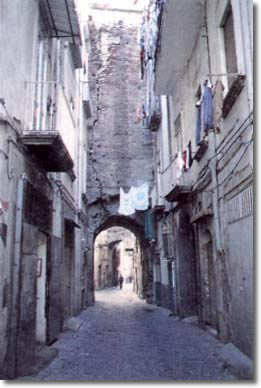
- via anticaglia
From Largo Regina Coeli, where stands the convent complex of Santa Maria Regina Coeli, a convent which contains paintings by Stanzione, Luca Giordano and Micco Spadro, we go long Via Pisanelli. As we pass under the octagonal campanile of the church, to the left w see the 17th-century monastery of S. Maria di Gerusalemme known as the Church of the Trentatre, a name deriving from the number of nuns who were cloistered there.
In the nearby Via L. Armanni stands the hospital of Santa Maria del Popolo of the Incurables, founded in th 16th century with the splendid Pharmacy of the 18th century. Via Anticaglia is so called after the structure of the brick arch (2nd century BC), the brick of which serve as reinforcement to the "cavea" of the Roman Theatre where the Emperor Nero performed.
The open-air theatre and the Odèion occupy the area between Via Anticaglia, Via San Paolo and the convent of S. Paolo Maggiore. We see Palazzo Avellino, in the small square of the same name dating from the end of the 14th century, built for Ottino Caracciolo, Prince of Avellino and enlarged in the 17th century.
We reach Via Duomo, one of the ancient cardinal points of the city which takes its name from the imposing Cathedral that houses so many works of art and here the miracle of the liquefaction of the blood of San Gennaro takes place. The square where the 14th-century Palazzo dell'Arcivescovado stands takes the name of Donnarumma from the baroque church near the 4th-century one of the same name.
Further on, we come to the Church of the Santissimi Apostoli, founded in the 5th century on the same spot as a pagan temple. At the end of Via Carbonara (Carbonarius), outside the Anjevin walls, used during the Middle Ages for dumping refuse and later for jousts and tournaments, there stands, high up with a view of the Sanfelice, the complex of San Giovanni a Carbonara, an impressive example of Renaissance sculpture.