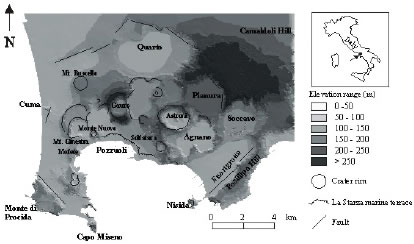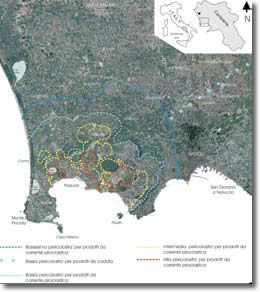
- Map of the volcanic risks of the Phlegaean Fields
Brief outline of the volcanic activity of the Phlegraean Fields
Geographically, the Phlegraean Fields covers an active volcanic area stretching from the Posillipo ridge northwards to Cuma. In effect, a distinction is made between this area, known as the Continental Phlegraean Fields, and the so-called Insular Phlegraean Fields - that is, the islands of Ischia, Procida and Vivara.
The products of the oldest volcanic activity (Paleo Campi Flegrae) are found on the islands of Procida and Vivara, in the Monte di Procida area and in the quarries bordering the Quarto Plain. The real volcanic activity of the Phlegraean Fields began with the great eruption of the Ignimbrite Campana (circa 39 kaB.P. - De Vivo et al., 2001).
This created a pyroclastic stream which spread over the Campania Plain as far as the carbonate spurs of the Monti Lattari and Picenti to the south and the Roccamorfina area to the north. There is no consensus on where the centre of the Ignimbrite Campana eruption was (I.C.).
Some writers associate it with the calderic collapse that caused a vast area corresponding to the present-day Phlegraean Fields to subside. Others see the Ignimbrite Campana as a product of a huge eruption of a fissural nature deriving from a series of fractures in the wider area of the plain.
Since the eruption of I.C., the Phlegraean Fields have seen only limited volcanic activity, the products being traceable within the city of Naples, along the Posillipo ridge, and above all on the Camaldoli Hill (Di Girolamo et al., 1984). These products consist of eject of variable welding, generically known as Old Tufo of the City of Naples. Products of the same era are to be found on the island of Procida.