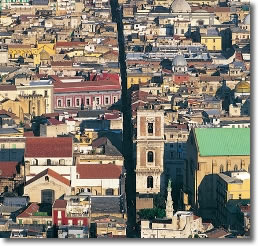
- Spaccanapoli
We begin our visit in Piazza del Gesù Nuovo, so called after the baroque Jesuit church built in the area of the Renaisance palazzo Sansevero, of which it retains the diamond-pointed rusticated façade; the fulcrum of the area is the baroque guglia dell'Immacolata, erected between 1747 and 1750 with funds from public subscription.
We walk down Via Benedetto Croce lined by monumental noble palazzi, among which is Palazzo Filomarino where the philosopher Benedetto Croce lived and died. The road leads into Piazza San Domenico Maggiore with the polygonal apse of the church of the same name and the gothic portal of Sant'Angelo a Morfisa, closed on the other three sides by important aristocratic palazzi: Petrucci, Casacalenda, Sangro di Sansevero and Corigliano.
In the centre, the wonderful guglia of C. Fanzago and D.A. Vaccaro, erected to give release from a vow made during the plague of 1656. A visit to the Sansevero Chapel is a must; here you can se the Veiled Christ, a famous masterpiece of Neapolitan sculpture by Giuseppe Sanmartino.
Along Via San Biagio dei Librai, so called because of the bookshops that were once there, and now goldsmiths, we see several Renaissance palazzi: the Monte di Pietà with its annexed Chapel, Marigliano and Carafa Santangelo. Along Via Duomo, don't miss the Church of S. Giorgio Maggiore, built between the end of the fourth and the beginning of the fifth centuries, but redesigned by Cosimo Fanzago in the 17th century. In the 19th century, one of the naves was eliminated in order to widen Via Duomo.