Our tour begins in lively Piazza Bellini with its literary cafés and background of the 18th-century piperno stairway leading to the ex-convent of Sant'Antoniello a Part'Alba, the Greek walls in the centre dating from the Neapolis of the 4th century BC. It includes Via San Pietro a Maiella where the Academy of Music is situated, and Via Tribunali with its 16th-century palace of the Dukes Spinelli di Laurino, which was transformed in the 18th century by the architect Ferdinando Sanfelice.
This road has the medieval arcades of the palazzo of Philip of Anjou (or the Emperor), prince of Taranto and Emperor of Constantinople, and here there is a picturesque market. The present-day Piazza San Gaetano is situated in the area of the Greek Agorà and the Roman Forum and is still the place where the heart of the old town beats.
To the right is the famous Via San Gregorio Armeno, so well known for its artisans' workshops making shepherd figurines, artificial flowers and Christmas cribs. Over the Christmas period, this street crawls with crowds of people when the stalls overflow with colourful things to buy. Of great interest is the layout of Piazza Riario Sforza, tightly contained in the area between the steps of the secondary entrance to the Duomo and the magnificent dome of the Chapel of San Gennaro, with Naples' oldest guglia monument to the saint at its centre.
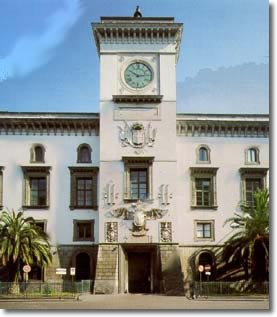
This area, which was once used for festivities outside the San Gennaro Chapel, was immortalised in a famous watercolour painting by the Neapolitan painter Giacinto Gigante. At the end of the Main Decuman stands the impressive Royal Palace-Fortress of Castel Capuano, with its ancient entranceway to the city, reconstructed in Renaissance style.
 Go to Via Tribunali on the map (Google Maps)