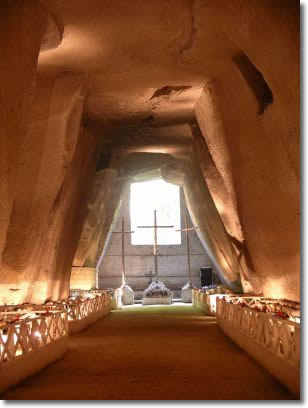
- an interior of Fontanelle's cemetery
From the hills which today are called Colli Aminei, started 4 streams which, engraving the tuff, created a sort of valleys in which the so called "Virgins' lava" flowed.
The Virgins' lava has been eroding the Fontanelle and Sanità's valleys for millenniums, creating the right conditions to extract the tuff.
The Fontanelle street itself, represents the old stream whose banks are full of caves; these caves, up to the last century, provided the material for the building trade and, today, they are used as store of olives, glass works, chocolate or marble factories, garages and cellars.
At the mid of the XVI century, the lava created a huge pothole on the Fontanelle street and so, it was ordered to plug up that pothole with "sfabbricatura";
In that period, dead people had been buried in the churches but, since there wasn't space any more,the gravediggers, in the night, exhumed the corpses and carried them to the deserted caves.
After another flood, many corpses stepped out of the caves and, the inhabitants of Sanità didn't get out of home because they didn't want to see their deceased.
The gravediggers had the order to place the corpses in the last cave.
But the origin of this charnel house, can be brought back up to the XVI century when, the city was flogged by 3 popular riots, 3 famines, 3 earthquakes, 5 eruption of Vesuvio and 3 pandemics and, because it was an isolated place,the corpses were placed there.
The famine in 1656 was awful, the walls of the caves had to be knocked down to hold 250000 corpses out of 400000 inhabitants, someone says the victims were 300000.
The architect Carlo Praus tells us that in 1764, Fontanelle Cemetery was destined to bury the corpses of the lower class because there wasn't space in the churches any more.
Praus, after Saint Cloud edict (1804), presents a project to build a large cemetery widening the ancient Fontanelle's necropolis.
In 1837, after the epidemics of colera morbu, other corpses were buried in this cemetery. In the same year, it was ordered to take the bones out from the churchyards and to carry them to the
Fontanelle's charnel house and so, many waggons escorted by monks and guards carried heaps of remains. The cemetery had been deserted up to 1872, when the clergyman of the church Materdei, Don Gaetano Barbati, putted the bones in order, in the order we can see today; they are anonymous except for 2 skeletons: the skeleton of Filippo Carafa, earl of Cerreto of the dukes of Maddaloni who died on 17 July 1797, and the Donna Margherita Petrucci's (born as Azzoni) one who died on 5 October 1795; both of them rest in peace into coffins and glasses protect them.
The corpse of Donna Margherita has been mummified and the skull has a wide open mouth as if she vomited; for this reason the rumour has it that the peeress died strangled by a dumpling.
Ordering the bones, the ones which came from parishes had been putted in the nave at the back of the church; the nave was called "nave of the priests". The central nave was called "nave of the lepers". The last nave was called "nave of the pezzentelli" because in that nave the lower class was buried.
Today the cemetery is place of both cult and macabre fascination which has given rise to legends and miracles' tale.